Date: 9th October 2019
Studio Practice I – Recording Acoustic Guitars and Double Bass
During this class, I learned:
- Fundamentals of the studio we were going be using for the rest of the semester, some of the things were:
- Workflow from the studio to the console.
- Use of Phantom Power.
- How to properly correct the levels.
- How to record.
- Importance of File Management and how we were supposed to use it for our assignment.
- Basics about Pro Tools (creating new tracks, how playlists work, how to record, Mix and Edit window, etc.)
- Recording Microphone technique for the Acoustic Guitar, we used two Microphones this class:
- Rode NTR Active Ribbon, we used this for recording the body and obtain more of the low frequency notes.
- Neumann KM 184 Condenser, we used this for recording the 12th fret and obtain more of the mid/high frequency notes.
- Recording Microphone for Tambourine:
- AKG C414 Condenser.
Date: 16th October 2019
Studio Practice II – Recording Piano
During this class, I learned:
- Different stereo recording techniques, some of them were:
- Mid-side.
- Blumlein.
- X-Y.
- ORTF.
- Different recording positions for recording the Piano:
- 4 mics on top:
- 2 C414 Condenser and 2 Neumann KM 184 Condenser (not 100% sure).
- 1 mic under:
- TLM 103 Condenser.
- 1 mic for ambient:
- AT 4081 Ribbon.
- 4 mics on top:
- In order to obtain the true sound of the piano, we need to pan the mics before recording.
- Proximity effect comparing the Ambient sound with the rest.
Date: 23st October 2019
Studio Practice III – Recording Drums
During this class, I learned:
- Recording a drum kit can be as specific as we want, we can choose to record every part of the drum or just some of it and obtain a different sound from de ‘spill’ of the drums into the microphones.
- Recording Drum Techniques:
- Overheads must be at an equidistance from the Snare, because this is the ‘centre of the kit’.
- For obtaining different and more tones, you can record the upper and under part of the drums.
- Different positions for the Kick Drum.
- In the console:
- Application of high and low pass filters.
- For recording we used:
- Various SM 57 Dynamic, since it’s the most common mic for drums.
- 2 Rode NTR Ribbon as overheads (not 100% sure).
- 1 Shure Beta 52A for the drum kick (not 100% sure).
Date: 6th November 2019
Studio Practice IV – Recording Electric Guitar and Bass
During this class, I learned:
- How to properly microphone an amp.
- Recording Microphone Techniques for amps:
- 4 Mics in 1 amp (Guitar):
- 2 SM 57 Dynamic, 1 pointing straight and 1 in a 45-degree angle.
- 2 KM 184 Condenser, 1 pointing straight and 1 in a 45-degree angle.
- Since the SM were Dynamic Microphones, I learned that most even though dynamics microphones don’t need Phantom Power, we could put them in the same rack, but if that wouldn’t work, another technique is to put them in a different rack than the condensers so that the impedance won’t affect the dynamic ones.
- 3 Mics, 2 in amp and 1 for ambience (Bass):
- 1 Rode NTR Ribbon, gives a darker tone.
- 1 SET 2 (don’t remember the actual microphone), giving a lighter tone.
- 1 Rode NTR Ribbon at a more distant position, it gives a neutral tone thanks to the proximity effect.
- 4 Mics in 1 amp (Guitar):
- I learned the effect that the placement and position of the microphones has regarding the tone of the recording instrument.
Date: 13th November 2019
Studio Practice V – Recording Vocals and Brass
During this class, I learned:
- Proper recording techniques for vocals.
- Use of
2 microphones for recording the same voice, 1 on top of
each other:
- Sontronics ARIA Condenser, this mic gave a much ‘warmer’ tone for the voice, making it more natural.
- Neumann U87 Condenser, this mic gave the vocals a more ‘digital’ tone.
Date: 14th November 2019
Recording Day – Recording Assessment
For this recording I wanted to incorporate things I learned throughout the whole semester:
- Acoustic Guitar Class
- Rode NTR Active Ribbon, recording the body.
- Neumann KM 184 Condenser, recording the 12th fret.
- Tambourine:
- AKG C414 Condenser.
- Piano Class
- Stereo recording techniques
- Mid-side.
- Different recording positions for the Piano:
- 1 mic under:
- TLM 103 Condenser.
- 1 mic for ambient:
- AT 4081 Ribbon.
- 1 mic under:
- Stereo recording techniques
- Drums Class
- Recording Drum Techniques:
- Overheads must be at an equidistance from the Snare, because this is the ‘centre of the kit’.
- Recording Drum Techniques:
- Electric Guitar and Bass
- 4 Mics in 1 amp (Guitar):
- 2 SM 57, 1 pointing straight and 1 in a 45-degree angle.
- 2 KM 184, 1 pointing straight and 1 in a 45-degree angle.
- 4 Mics in 1 amp (Guitar):
- Vocals
- Use of 2 microphones for recording the same voice, 1 on top of each other:
- Neumann U87 Condenser, this mic gave the vocals a more ‘digital’ tone.
- Use of 2 microphones for recording the same voice, 1 on top of each other:
Project Explanation
I used 6 mics, when I first thought of this was because I’ve previously worked with live orchestral performances, and I had already learned about a technique that Tomlinson Holman in ‘Surround Sound Up and Running’ explains as ‘Pan Pot Stereo’ and another one as ‘Spot Miking’:
- Pan Pot Stereo consists on placing several microphones throughout the orchestra, in proximity to the instruments in order to obtain an isolated sound from each of them.
- Spot Miking consists on, as the previous one, to place several microphones across the orchestra, with the difference that in this one, there would be an emphasis in one instrument (or group of instruments, mostly the soloist) above the rest.
What I wanted to do here was to treat my guitar as an ‘orchestra’, recording several parts of it, from several angles, with several different types of microphones, searching to obtain an isolating sound from each ‘section’.
I forgot to take photos on the recording day, but this is what I did:
Acoustic Guitar:
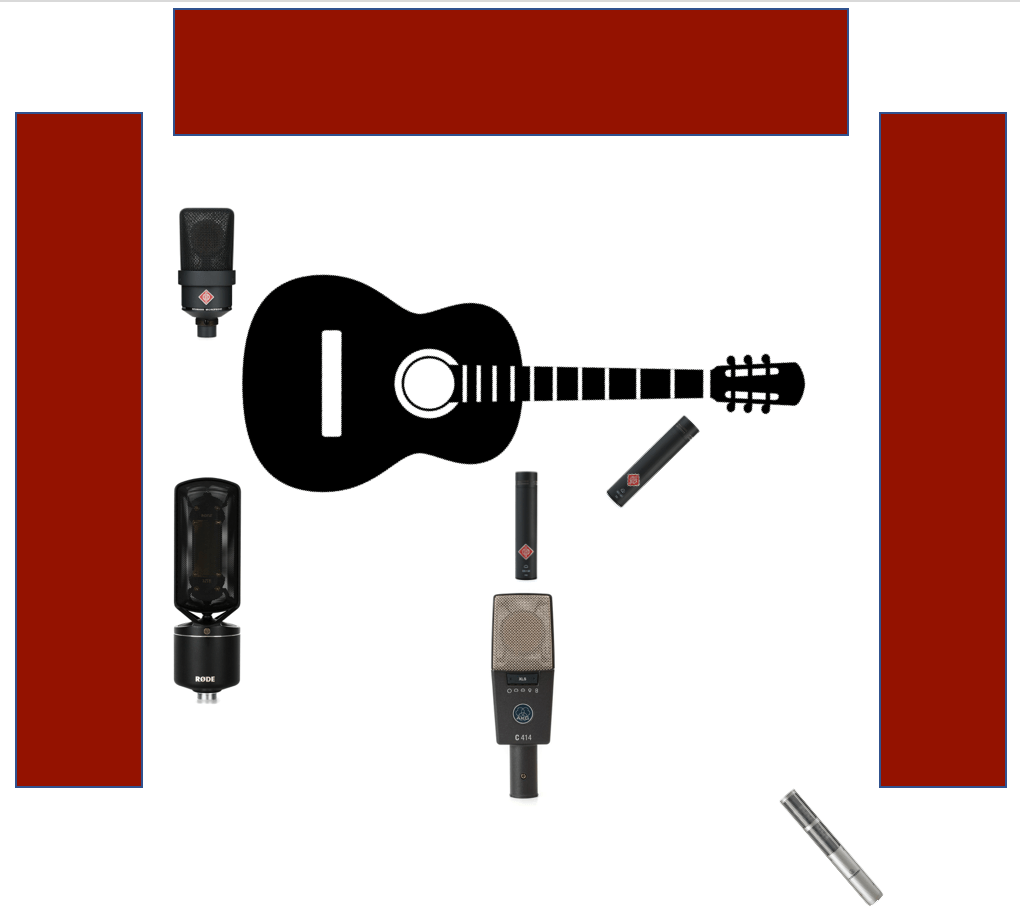
- I used 4 condensers and 2 ribbon microphones for recording the acoustic guitar. I chose the condenser mics because the dynamics are mostly used in live performances, and when used in studio is for either powerful vocals or big sounding instruments, like drums or electric guitars, because they need great amounts of energy for them to work properly, making them less responsive (also because of the weight of its mechanism) than either the ribbon or the condenser mics.
- My song was going to be a fingerstyle acoustic song, so I needed the receiving signal to be more clear and accurately, and for that, the condenser mics work better, they respond to fast attacks better than the other two types of mics.
- Also, I wanted the bass frequencies to feel warmer and precisely, and high frequencies to have more tone, which is why I used the proximity effect in both Ribbon mics, placing one very close to the body of the guitar and one the furthest from it.
- I wanted it to be
divided into 3 sections:
- Low frequencies:
- 1 Rode NTR Active Ribbon, in front of the body:
- Like I said previously, I wanted it to capture the low frequency notes more than the mid and high ones, which is why I used it at the bottom part of the body.
- Here I applied the proximity effect, which Bill Gibson in ‘The S.M.A.R.T
guide to Mixers, signal processors, microphones, and more’ describes in a
simple way:
- When a sound source is closer to the microphone, the low frequencies will increase in range, taking more presence than if we were to put it further away (also, the closer it is, the more it cancels higher frequencies).
- I also placed it in a low position, because as physics states, low frequencies travel greater distances at low height.
- 1 TLM 103 Condenser behind the body:
- We used it to record the low frequencies of the piano, placing it under it. The logic I used here was that, if it could capture low frequency notes from the piano, it could capture the ones coming from behind the guitar. When I finished recording, I noticed that this mic was bringing a lot of noise, so I decided not to include it. Later, I realized that the cable was damaged and that’s why the mic didn’t record properly.
- 1 Rode NTR Active Ribbon, in front of the body:
- Mid frequencies:
- 1 AKG C414 Condenser
- 1 KM 184 Condenser
- Here I placed both on the 12th fret of the guitar, I wanted to capture the mid frequency tone from two different perspectives.
- At first, I was going to use the ‘mid-side’ recording technique we
learned on the piano class, where we place a cardioid mic pointing directly at
a source, on top of a figure of eight pattern pointing sideways. The problem
with this was that, according to Holman, the front and back halves of a
microphone have opposite polarity voltage (one positive and the other
negative), he explains that:
- The sum of the cardioid pointing directly, and the Figure-8 being sideways, results on a left-forward facing sound.
- Subtracting them results in a right-forward sound.
- So, in order to avoid this, in the mix session we have to duplicate the recording and make a phase inversion, making the right halve be in phase with the left one.
- When recording, I realized that I was not aiming for that difference in sound, I just wanted to hear the difference from a unidirectional and a figure of eight pointing at the same spot, so I just placed them both pointing directly.
- High frequencies:
- 1 KM 184 Condenser
- Here I wanted to record the nut of the guitar, where the fretboard starts, because there is where the less low frequency notes the guitar produces.
- I thought of using the ORTF technique, which consists in pointing two cardioid mics at a 110-degree angle, but this technique, as explain by Holman, is mostly used to obtain a surround sound. Since I was not looking for a surround sound, I used the previously mic pointing directly at the 12th fret and the other at a 45-degree angle, this would still give me a difference in the sound, obtaining an even ‘lighter’ response than if I were just pointing it directly to the nut (I learned this technique at the ‘Electric Guitar and Bass Class’).
- 1 AT 4081 Ribbon
- We used this mic during the ‘Piano Class’ to record ambience and a ‘lighter’ and more distant sound from the piano.
- In the guitar, I didn’t only want the ambience sound, I also placed it higher in order to capture most of the high frequency notes, since those travels through air in the opposite way low frequency notes do. When listening back to this recording, this mic captured more ambience sound than I was expecting, so I decided not to use this one either.
- 1 KM 184 Condenser
- Low frequencies:
Vocals
- For vocals at first I thought of using dynamic microphones because I know that in studio, the dynamics one do work for this thanks to the amplification of the signal they do, but like I mentioned earlier, it’s for powerful vocals or big sounding instruments, because they need great amounts of energy for them to work properly, and since my song wasn´t like that, I decided to go with the condenser.
- I used 2 condenser
microphones, using the technique of 2 at the same time, one on top of each
other (I didn’t want to mess with the external power source and risk doing
something wrong so I didn´t use the ARIA.):
- AKG C414 Condenser (top)
- Neumann U87 Condenser
(bottom)
- Since previously stated, the Neumann did give a more digital sound, but it also was darker than the C414 because it was in a lower position, so I decided to go with the AKG C414.
Tambourine
- Here I was just going
to record the C414 because it was the one we used for recording it the first
class thanks to its quickly transient response, but I wanted to try something
different:
- AT 4081 Ribbon
- I decided to use the AT 4081 Ribbon mic, because since it’s a ribbon microphone, I knew that if I placed it a little farther away from the tambourine, kind of what we did with the overheads in the ‘Drums Class’, the high frequency notes it would capture would be more clean and natural, ‘smoothing’ the signal.
- AT 4081 Ribbon
References
Holman, T. (2008): Surround sound up and running (Chapter 3). UK: Focal Press.
Gibson, B. (2005): The S.M.A.R.T guide to Mixers, signal processors, microphones, and more (Chapters 1 and 5). Canada: Artist Pro Publishing.
*I did not quote what the authors wrote when I previously mentioned them because I didn’t write their explanation, instead I wrote what I understood from the reading I did.
 Production Diary/ Recording and Mixing 2019